Update, I was scheduled for my Formal NDR board first week of Jan 2024. the day before, I was informed just before the board conviened that the board agreed to refer my case back to HRC for another review if I waived the proceeding. I guess I m a little confused they are the ones that stated it was non-duty related to begin with.. The OSC believes we can always request another FPEB if needed.. sounds like another long waiting game.. anyone have a similar experience. Thanks in advance.

You are using an out of date browser. It may not display this or other websites correctly.
You should upgrade or use an alternative browser.
You should upgrade or use an alternative browser.
I was referred for NoN-duty PEB
- Thread starter mos63b
- Start date
Update.
I was sent to a Non-Duty Related PEB. This process has been going on for well over a year. I made it to a FPEB on the day of the board, I was offered a reconsideration based off medical documentation which was found in my VA and C-file. The OSC was very helpful in the process. I just received some good news as I was granted a new ILOD. The NON-Duty Related LOD is administratively closed. I am now being told that I must go through a whole new MEB process again from the beginning due to this being a new LOD. I am glad its favorable but now it could take another year or longer. This will probably be a new record on the longest process to reach some type of finale conclusion.
In Waiting Mode now…….
I was sent to a Non-Duty Related PEB. This process has been going on for well over a year. I made it to a FPEB on the day of the board, I was offered a reconsideration based off medical documentation which was found in my VA and C-file. The OSC was very helpful in the process. I just received some good news as I was granted a new ILOD. The NON-Duty Related LOD is administratively closed. I am now being told that I must go through a whole new MEB process again from the beginning due to this being a new LOD. I am glad its favorable but now it could take another year or longer. This will probably be a new record on the longest process to reach some type of finale conclusion.
In Waiting Mode now…….
mos63b, i found your story to be very interesting.
I was referred to a ND-PEB (Feb 27th, 2024 ) recently for a condition that existed prior, but was aggravated by service (I was on AGR orders for 6 years when it got to the point i sought medical intervention ) . RetiredAttny offered very similar advice in my thread and I'm taking notes of how your case is going.
And it sounds like, at the pace this will take, I'll end up getting my 20 year letter before this is resolved !
I was referred to a ND-PEB (Feb 27th, 2024 ) recently for a condition that existed prior, but was aggravated by service (I was on AGR orders for 6 years when it got to the point i sought medical intervention ) . RetiredAttny offered very similar advice in my thread and I'm taking notes of how your case is going.
And it sounds like, at the pace this will take, I'll end up getting my 20 year letter before this is resolved !
Duckmeat, this process is very challenging. I originally started with an NDR PEB. I kept pushing for a fair resolution. I requested an FPEB. I was lucky. I had a good attorney from the Office of Soldiers Counsel. He listened to what was going on and was able to write a contention memo explaining my circumstances. The day before the board my packet was sent back to HRC for ILOD second look based on evidence the first MEB did not look at.
I was able to get a new ILOD (in the line of duty). Which should have been from the beginning. This process started well over one year ago. Now, this week, I was just told my packet was sent to the MEBTO to determine if my issues were in the line of duty. (Can’t make this up)
I guess, what I am trying to say is it will be another year before, I am done with the IDES process with the hopes that they are fair on my final disability percentage. If not its back to FPEB.
If you can manage to make it to your retirement that’s a smart move. I would still push through the process if you were injured in the line of duty. Many military members on this Forum have gone through some tough times as well. Hang in there brother.
I was able to get a new ILOD (in the line of duty). Which should have been from the beginning. This process started well over one year ago. Now, this week, I was just told my packet was sent to the MEBTO to determine if my issues were in the line of duty. (Can’t make this up)
I guess, what I am trying to say is it will be another year before, I am done with the IDES process with the hopes that they are fair on my final disability percentage. If not its back to FPEB.
If you can manage to make it to your retirement that’s a smart move. I would still push through the process if you were injured in the line of duty. Many military members on this Forum have gone through some tough times as well. Hang in there brother.

@mos63b make sure to keep learning about the process. Once you move over to regular IDES the fight starts all over again. If you need a new commanders impact statement see if your commander will let you write up a draft he/she could use as a reference. Make sure to have all your ducks in a row (PUN intended) for your C&P exams so that hopefully your VA% rating is correct because that % will be used for any conditions that the IPEB finds unfitting. Read over your NARSUM carefully and be prepared to submit a rebuttal or to request a IMR if something is wrong. Its very much a hurry up and wait process but in between those periods of activity you can work on making sure that you get the poper result. Also, your DOD% can't be changed for a single unfitting condition by the PEB. That requires a VARR request. The only way the PEB can change your DOD% is by adding or removing unfitting conditions.Duckmeat, this process is very challenging. I originally started with an NDR PEB. I kept pushing for a fair resolution. I requested an FPEB. I was lucky. I had a good attorney from the Office of Soldiers Counsel. He listened to what was going on and was able to write a contention memo explaining my circumstances. The day before the board my packet was sent back to HRC for ILOD second look based on evidence the first MEB did not look at.
I was able to get a new ILOD (in the line of duty). Which should have been from the beginning. This process started well over one year ago. Now, this week, I was just told my packet was sent to the MEBTO to determine if my issues were in the line of duty. (Can’t make this up)
I guess, what I am trying to say is it will be another year before, I am done with the IDES process with the hopes that they are fair on my final disability percentage. If not its back to FPEB.
If you can manage to make it to your retirement that’s a smart move. I would still push through the process if you were injured in the line of duty. Many military members on this Forum have gone through some tough times as well. Hang in there brother.
Last edited:
When does an NDR notification come?
I’m being told that my certified letter is on its way to start the process”
Sorry if that’s a dumb question, I’ve been VA rated for some time, and I’ve now triggered an MEB via PULSHES becoming 3s
My Case manager said to ”expect a certified letter”, and my rediness NCO sent an email with the subject “your MEB/NDR”
So I don’t know if I need to start educating myself on the NDR side of things…(everything happened due to combat injuries, but we know how the military is…)
I’m being told that my certified letter is on its way to start the process”
when you say “originally started” with a NDR, does that mean the original certified letter you received said they are sending you to an NDR-MEB?Duckmeat, this process is very challenging. I originally started with an NDR PEB. I kept pushing for a fair resolution. I requested an FPEB. I was lucky. I had a good attorney from the Office of Soldiers Counsel. He listened to what was going on and was able to write a contention memo explaining my circumstances. The day before the board my packet was sent back to HRC for ILOD second look based on evidence the first MEB did not look at.
I was able to get a new ILOD (in the line of duty). Which should have been from the beginning. This process started well over one year ago. Now, this week, I was just told my packet was sent to the MEBTO to determine if my issues were in the line of duty. (Can’t make this up)
I guess, what I am trying to say is it will be another year before, I am done with the IDES process with the hopes that they are fair on my final disability percentage. If not its back to FPEB.
If you can manage to make it to your retirement that’s a smart move. I would still push through the process if you were injured in the line of duty. Many military members on this Forum have gone through some tough times as well. Hang in there brother.
Sorry if that’s a dumb question, I’ve been VA rated for some time, and I’ve now triggered an MEB via PULSHES becoming 3s
My Case manager said to ”expect a certified letter”, and my rediness NCO sent an email with the subject “your MEB/NDR”
So I don’t know if I need to start educating myself on the NDR side of things…(everything happened due to combat injuries, but we know how the military is…)
JakeTrilla, I can only speak for myself. I received an NDR Memo from the MEB at HRC. They emailed it to me using the SAFE program. They also stated my injuries were not duty-related. I would believe your case manager will have a copy for records once it's received. When you get this memo, I suggest you get with your legal office ASAP if you are claiming injuries ILOD. good luck.....
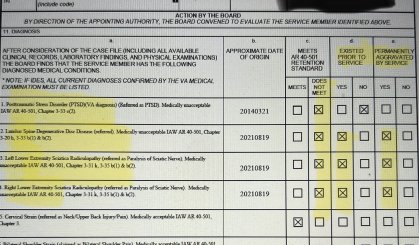
I am currently going thru the Army MEB. Just received my NARSUM 3/28/24. I had LOD for referred unfitting conditions, for my back. Even with LOD, the MEB board said the back EPTS “existed prior to service”, (ETPS) but they MEB did state “permanently aggravated by service” (PAS).
Do you guys know if the PAS is enough for the PEB to grant DOD ratings? Not sure if I should do an MEB appeal for ILD full boat or PAS is enough. I already have medical opinions from the LOD doctor and others that said the back conditions was caused on AD tour, but I don’t have medical documentation from that incident (x-rays etc). I do have memorandums for records from soldiers who witnessed the injury. Not sure if the MEB is gonna kick it back to the Army for a Formal LOD which would take 1 plus years. Don’t wanna restart this whole thing, especially if PSA is enough.
Thoughts?
Do you guys know if the PAS is enough for the PEB to grant DOD ratings? Not sure if I should do an MEB appeal for ILD full boat or PAS is enough. I already have medical opinions from the LOD doctor and others that said the back conditions was caused on AD tour, but I don’t have medical documentation from that incident (x-rays etc). I do have memorandums for records from soldiers who witnessed the injury. Not sure if the MEB is gonna kick it back to the Army for a Formal LOD which would take 1 plus years. Don’t wanna restart this whole thing, especially if PSA is enough.
Thoughts?
Attachments
MSG Raven2-3
It has been my experience that even if your injury occurred prior to your military service and it was aggravated on active duty during your service it will be recognized. You mentioned you have an iLOD and witnesses for the day of the incident. I am not sure how they rate within the PEB however, if this makes you unfit due to the aggravation, I believe they should rate it fairly. If for some strange reason they didn't then there is always the FPEB. Good Luck.
It has been my experience that even if your injury occurred prior to your military service and it was aggravated on active duty during your service it will be recognized. You mentioned you have an iLOD and witnesses for the day of the incident. I am not sure how they rate within the PEB however, if this makes you unfit due to the aggravation, I believe they should rate it fairly. If for some strange reason they didn't then there is always the FPEB. Good Luck.
Yeah just looking at the options. If I concur with the MEB NARSUM I will go to PEB with “aggravated by service” which should be good to go for my back conditions. I was determined ILD for PTSD looks like a good shot for 70% for PTSD. The back conditions are extras but I feel a moral obligation for the Army to recognize it. Back conditions should come in at a 30% if service aggravation flies.
Either way, if PEB gets squirley I still have LOD and other medical opinions/memos from buddies on hand ready for rebuttal.
Either way, if PEB gets squirley I still have LOD and other medical opinions/memos from buddies on hand ready for rebuttal.
Update: Well, now that I am finally in the IDES process, I just finished my Head & Toe exam and C&P for Neck, Upperback, and Migraines; I am currently awaiting my Narsum any day. It's been almost 2 years since I began with Non-Duty Related PEB. I still have a ways to go. I hope this journey is worth the ride. It has been so frustrating. Now I worry about whether I will hit the 30% mark per DOD... I know many of you are feeling this as well. Good Luck to all of you...
Question,
Hello,
The MEB found three issues out of 8 Not Fitting. Now, it is at the PEB. I think they will combine conditions 1&2. ....... anyone have a similar issue? Currently waiting on Ratings from PEB.
Condition #1: Cervical Degenerative Disc Disease other than IVDS
Condition #2: Cervical Spinal Stenosis
Condition #3 Migraines
Hello,
The MEB found three issues out of 8 Not Fitting. Now, it is at the PEB. I think they will combine conditions 1&2. ....... anyone have a similar issue? Currently waiting on Ratings from PEB.
Condition #1: Cervical Degenerative Disc Disease other than IVDS
Condition #2: Cervical Spinal Stenosis
Condition #3 Migraines
Finally, After more than two years in this process, I am done, starting with NON-Duty-related PEB and then getting a LOD approved. This forum has helped with a lot of good information. The hardest part of the process is the waiting, of course. I am well over 30% and got my retirement orders. It wasn't an easy process, but fair, and that's all I asked for. For those who will ask, conditions 1-2 were combined.Condition #1: Cervical Degenerative Disc Disease other than IVDS combined. Condition #2: Cervical Spinal Stenosis-combined. Condition #3 Migraines. This was all done while in IRR. Good luck to all in the process. Hang in there.
What do you mean they were “combined”? I have a pending PEB for DDD (lumbar) and radiculopathy. I expect 40% back and 20% each lower leg. Do you mean that PEB says “well his DDD and bilateral radiculopathy are ONE condition so we’ll just give him 40% and disregard the other 20s” so we’ll give him 40?
Congrats by the way..Army was trying desperately to put me on the ND related MEB/PEB. I fought like a rabbit dog for the LOD and got it just in the nick of time before the MEB started. Now I am on the duty related PEB
[B]MSG_Raven2-3[/B], I am speaking only about my case only... From my experience, reference radiculopathy it is rated separately. I was found fit with my radiculopathy. hope that helps.
Got it. It does help. It’s interesting some guys are “fit” and some “unfit” for the same conditions and percentages. Crossing my fingers my PEB “board” is not made up of unsympathetic individuals
A PEB has considerable latitude and discretion in determining what conditions render a Service member fit or unfit. The nature of the medical condition is one factor, but the PEB ultimately must determine the extent to which, if at all, the condition prevents a Service member from being able to reasonably perform their military duties. A Service member’s permanent profile and the profile’s functional limitations are often dispositive, although a commander’s functional assessment, any restrictions on ability to deploy not subject to waiver, physical fitness test results, or efficiency reports are factors a PEB may consider as well.
The PEB’s discretion is not unbounded, and the PEB may not combine conditions that are separately unfitting or that contribute to a Service member’s unfitness to avoid separately rating those conditions. This is an erroneous practice that each military department PEB often follows to the prejudice of Service members. Contrary to that practice, statutory authority requires that in determining the disability rating of a Soldier, a PEB is required to take into account all medical conditions, whether individually or collectively, that render the Soldier unfit. 10 U.S.C. § 1216a(b).
This statutory requirement to consider all medical conditions is implemented by the Department of Defense in its Disability Evaluation System Instruction, DoDI 1332.18, ¶ 6.4.d. (Nov. 10, 2022) (formerly at Appx. 2 to Encl. 3, ¶ 4.d. in prior version of DODI 1332.18), which provides in pertinent part:
"d. Combined Effect.
(1) A Service member may be determined unfit as a result of the combined effect of two or more conditions even though each of them, standing alone, would not cause the Service member to be referred into the DES [Disability Evaluation System] or be found unfit because of disability.
* * *
(3) Combined effect includes the pairing of a singularly unfitting condition with a condition that standing alone would not be unfitting."
The Army, for example, similarly describes this combined effect provision in Army Regulation 635-40, ¶¶ 5-4.g. and 5-5. Paragraph 5-4.g., provides:
Overall or combined effect. A Soldier may be determined unfit as a result of the overall effect of two or more impairments even though each of them, standing alone, would not cause the Soldier to be found unfit because of physical disability. Further, unfitness due to overall or combined effect may include one or more conditions determined to be unfitting in combination with an independently unfitting condition. Paragraph 5-5 provides: “The DES [Disability Evaluation System] compensates disabilities when they cause or contribute to career termination.”
It is well-settled that these statutory and regulatory provisions require that a PEB assign a separate disability rating to any medical condition that causes or contributes to the Soldier’s unfitness for duty even if another condition alone suffices to render a Soldier unfit. See Sissel v. Wormuth, 77 F.4th 941, 948-949 (D.C. Cir. 2023); Fuentes v. United States, 157 Fed. Cl. 433, 450-451 (2021); McCord v. United States, 131 Fed. Cl. 333, 347-348 (2017).
Based on the D.C. Circuit’s decision in Sissel, the Navy recently settled a class action lawsuit brought in the U.S. District Court for the District of Columbia by the National Veterans Legal Services Program challenging the Navy PEB’s practice of combining separately unfitting conditions or conditions contributing to unfitness and then limiting ratings to the combined conditions thereby reducing the Service member’s disability rating. See Springs v. Del Toro, No. 1:20-cv-03244 (RDM) (D.D.C. Mar. 23, 2024) (Joint Status Report) (copy attached).
The PEB’s discretion is not unbounded, and the PEB may not combine conditions that are separately unfitting or that contribute to a Service member’s unfitness to avoid separately rating those conditions. This is an erroneous practice that each military department PEB often follows to the prejudice of Service members. Contrary to that practice, statutory authority requires that in determining the disability rating of a Soldier, a PEB is required to take into account all medical conditions, whether individually or collectively, that render the Soldier unfit. 10 U.S.C. § 1216a(b).
This statutory requirement to consider all medical conditions is implemented by the Department of Defense in its Disability Evaluation System Instruction, DoDI 1332.18, ¶ 6.4.d. (Nov. 10, 2022) (formerly at Appx. 2 to Encl. 3, ¶ 4.d. in prior version of DODI 1332.18), which provides in pertinent part:
"d. Combined Effect.
(1) A Service member may be determined unfit as a result of the combined effect of two or more conditions even though each of them, standing alone, would not cause the Service member to be referred into the DES [Disability Evaluation System] or be found unfit because of disability.
* * *
(3) Combined effect includes the pairing of a singularly unfitting condition with a condition that standing alone would not be unfitting."
The Army, for example, similarly describes this combined effect provision in Army Regulation 635-40, ¶¶ 5-4.g. and 5-5. Paragraph 5-4.g., provides:
Overall or combined effect. A Soldier may be determined unfit as a result of the overall effect of two or more impairments even though each of them, standing alone, would not cause the Soldier to be found unfit because of physical disability. Further, unfitness due to overall or combined effect may include one or more conditions determined to be unfitting in combination with an independently unfitting condition. Paragraph 5-5 provides: “The DES [Disability Evaluation System] compensates disabilities when they cause or contribute to career termination.”
It is well-settled that these statutory and regulatory provisions require that a PEB assign a separate disability rating to any medical condition that causes or contributes to the Soldier’s unfitness for duty even if another condition alone suffices to render a Soldier unfit. See Sissel v. Wormuth, 77 F.4th 941, 948-949 (D.C. Cir. 2023); Fuentes v. United States, 157 Fed. Cl. 433, 450-451 (2021); McCord v. United States, 131 Fed. Cl. 333, 347-348 (2017).
Based on the D.C. Circuit’s decision in Sissel, the Navy recently settled a class action lawsuit brought in the U.S. District Court for the District of Columbia by the National Veterans Legal Services Program challenging the Navy PEB’s practice of combining separately unfitting conditions or conditions contributing to unfitness and then limiting ratings to the combined conditions thereby reducing the Service member’s disability rating. See Springs v. Del Toro, No. 1:20-cv-03244 (RDM) (D.D.C. Mar. 23, 2024) (Joint Status Report) (copy attached).
Attachments
Last edited:
Thanks for that information. It’s always good to know this before I speak to PEB counsel just for fact check and confirm the process.
Thank you!
Thank you!
Looks like similar battle for my sister. Could any one help with Soldier Counceling or Legal team contact or recommendation?